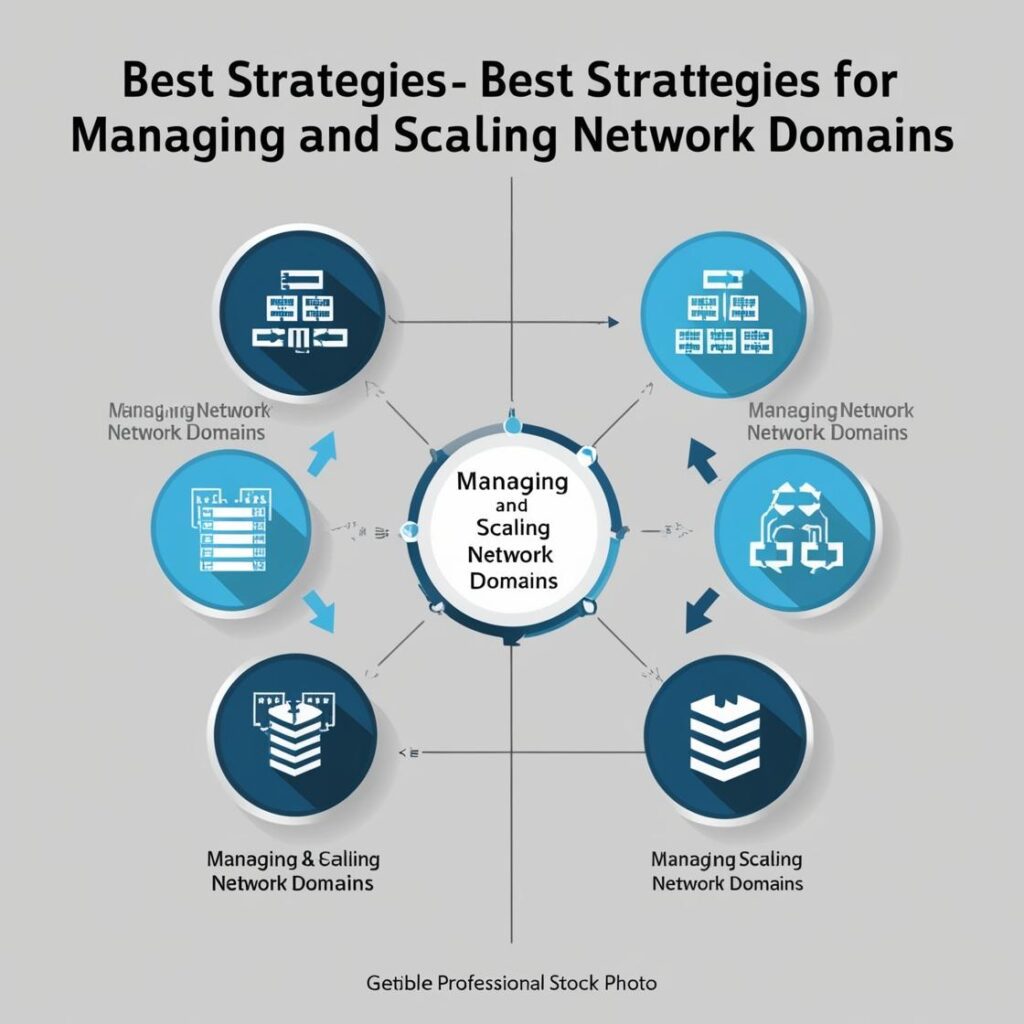
Managing and scaling networked domains effectively requires a combination of best practices in design, resource management and security. The following are some essential strategies:
1. Namespace Planning and Segmentation
- Organize the name area domains in a logical and hierarchical manner for the purpose of optimizing administration. For example, you can divide organizational units (OUs) by function (such as finance, human resources, etc.) or by geographic location.
- Network segmentation based on traffic and security needs. The use of several OUs makes it possible to propagate specific policies and simplify the assignment of permissions.
2. Use of Additional Domain Controllers
- In order to optimize redundancy and fault tolerance, it is essential to have multiple domain controllers that are available in different geographical locations. This avoids service downtime in case of failure of a single server.
- Domain controllers in the cloudConsider setting up domain controllers in the cloud to ensure that remote users authenticate faster and have greater disaster recovery capabilities.
3. Automation and Policy Management
- Implements group policies (GPOs) for the purpose of establishing a centralized configuration of users and computers on the network. During escalations, GPOs will help ensure consistency and compliance with security policies.
- Use PowerShell scripts or administration tools in order to automate common tasks such as creating users, assigning permissions and monitoring the status of domain controllers.
4. DNS and DHCP optimization
- Implements Dynamic DNS and establishes DNS zones integrated with Active Directory in order to simplify domain name management.
- Configure DHCP reservations for critical devices and adjusts grant times according to the needs of the network. When scaling, optimized DNS and DHCP configuration will help reduce IP conflicts and increase name resolution capacity.
5. Constant Monitoring and Auditing
- Constantly checks the operation of the domain controllers, as well as the network connections, authentications and resource usage on each one.
- Implements a comprehensive audit policy for the purpose of logging login events, changes to directory objects, and other relevant events. This is essential to ensure security and detect suspicious acts.
6. Security Enhancement
- Enables the encryption and multi-factor authentication (MFA) to secure access to the domain.
- Access is divided between administrators and users by means of minimum privilege roles and uses separate administrative accounts for high-level tasks.
- The aim is to create a firewall and VPN for remote connections, ensuring that external users can securely access domains.
7. Planning for Growth
- Configure the domain controllers with the required resources (CPU, RAM and storage) necessary to control anticipated growth.
- Use cloud or network attached storage (SAN) systems in order to ensure scalability of data and configurations.
8. Synchronization and Disaster Recovery
- Implements a synchronization strategy between sites if you have a distributed network, so that domain changes can be replicated quickly and securely.
- Implements a disaster recovery plan through the creation of backup copies of domain controllers and the implementation of controllers in the cloud in order to ensure fast recovery in case of data loss.
9. Training and Documentation
- Ensure that all administrators have a adequate training in domain management and adopt good security practices.
- Have a detailed documentation on the domain structure, configurations and policies adopted, which enables scaling and troubleshooting.
These strategies optimize the management of domains in social networks, increase system availability and enhance security as the network expands and becomes more complex.
Learn more http://Datasystem.es or in https://repararmac.eu/wp-admin/post.php?post=3661&action=edit